
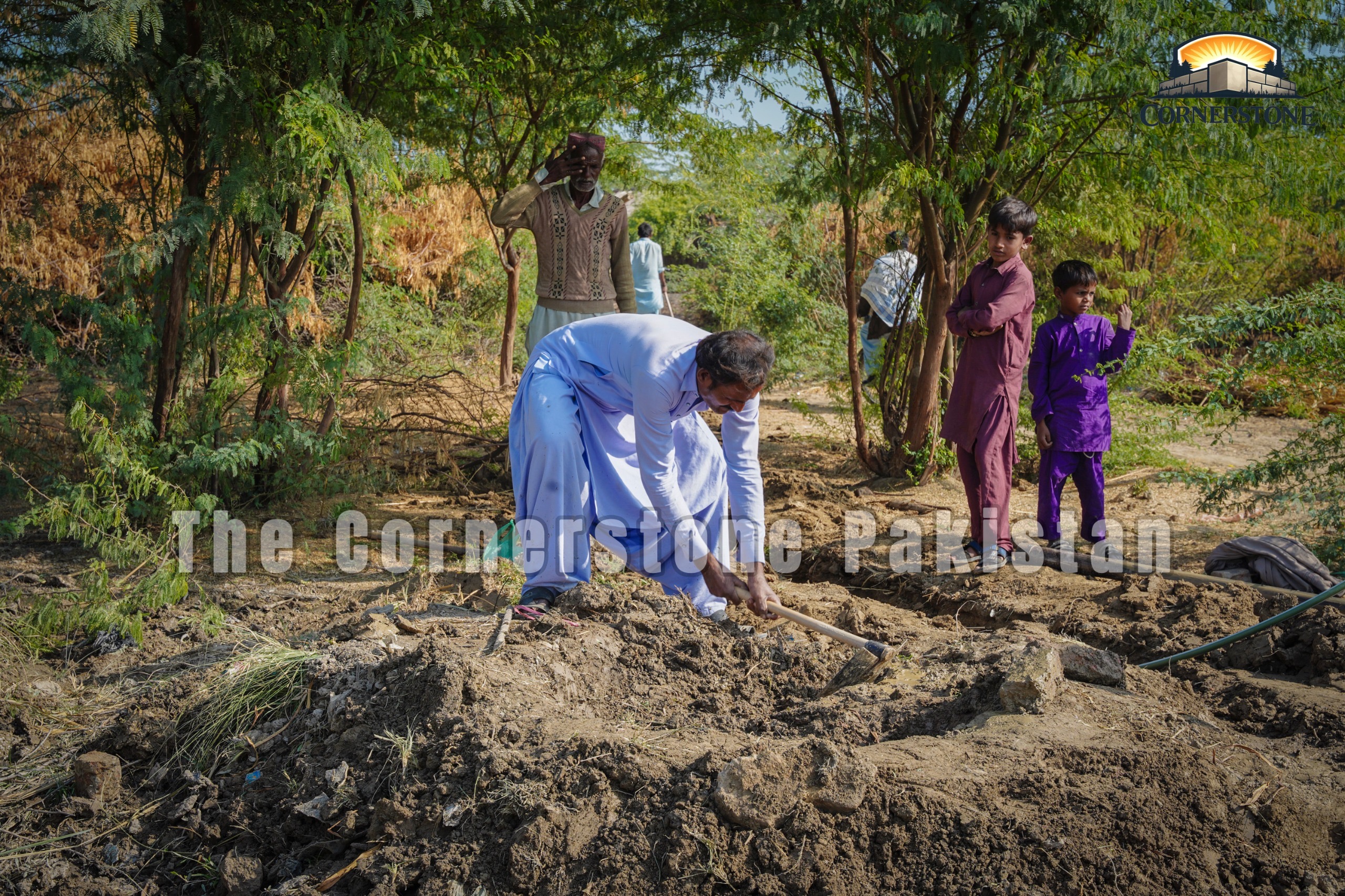
Water & Sanitation in Interior Sindh – A Crisis That Can No Longer Be Ignored
Water & Sanitation in Interior Sindh: A Crisis That Can No Longer Be Ignored
Published by Cornerstone Pakistan | April 2026
There is a moment, repeated thousands of times each day across the villages of interior Sindh, that tells you everything you need to know about the scale of this crisis. A woman leaves her home before dawn, walks miles under a scorching sun, and returns carrying a container of water that no one should drink, but everyone will. This is not an occasional hardship. It is daily life.
Interior Sindh is at the epicentre of one of the most severe water and sanitation emergencies in Pakistan’s history. While the crisis has been decades in the making, the situation in 2025 and 2026 has reached a point of urgency that demands immediate attention, honest conversation, and coordinated action.
The Scale of the Crisis
The numbers are staggering, and deeply human. Only about a quarter of Sindh’s population has access to safely managed drinking water, while waterborne diseases have increased silently across the province. A water quality assessment across Sindh found that only 2.13% of water samples were rated excellent, while more than 55% were classified as poor. DawnPubMed Central
In central Sindh, the situation is even more dire. In the Nawabshah district alone, approximately 70 to 74 percent of drinking water is unsuitable for human use, contaminated with E. coli bacteria, heavy metals, excessive sulfates, and agricultural pesticides, affecting 1.8 million residents. Pakistan Today
As of early 2026, Pakistan’s per capita water availability has fallen below 1,000 cubic meters per year, officially classifying it as a water-stressed country. Sindh, as a downstream province, bears the heaviest burden of this reality. The Grand Review
What Is Causing the Crisis?
The water and sanitation emergency in interior Sindh is not the result of a single cause; it is the product of compounding failures, both natural and man-made.
Climate Breakdown
Sindh recorded a 90% reduction in rainfall during the winter of 2024 to 2025, making it one of the driest seasons in the province’s recorded history. Droughts have dried up traditional water sources, while erratic flooding from previous years contaminated groundwater reserves and destroyed sanitation infrastructure. As groundwater turns saline from the lack of rain, crops wither, and livelihoods collapse, families are unable to access clean water, grow food, or generate income to purchase water elsewhere. The Borgen ProjectAction Against Hunger
Illegal Water Diversions and Provincial Inequality
Six unauthorized canals divert Sindh’s rightful share from the Indus River, violating the 1991 Water Accord that guaranteed fair distribution between provinces. As a downstream province, Sindh is consistently shortchanged, receiving far less water than it is entitled to, a source of growing anger and desperation among communities that depend on the Indus for survival. Concave AGRI
Crumbling Infrastructure
With sewage pipes and water supply pipes running alongside each other, leakages cause widespread contamination, exposing users to a host of deadly diseases. Decades of neglect have left water schemes non-functional, hand pumps broken, and sanitation facilities either absent or unusable. Rural water security remains marked by poor water quality, limited piped supply, sanitation deficits, and a high burden of waterborne disease, reflecting weak integration of WASH into climate adaptation planning. PubMed CentralDawn
The Indus Waters Treaty Suspension
Adding a geopolitical dimension to an already fragile situation, India suspended the Indus Waters Treaty in April 2025 following a military conflict, halting the sharing of hydrological data essential for flood forecasting, reservoir operations, and irrigation planning in Pakistan. While the physical diversion of water flows will take time to materialize, the suspension deepens long-term uncertainty for a province that is already on the edge. The Borgen Project
The Human Cost
Behind every statistic is a person, a child, a mother, a farmer, whose life is shaped by the absence of clean water and basic sanitation.
In the Thatta district of Sindh, families face a daily struggle for water that is not only scarce but also unsafe, leaving lasting impacts on their health. Health facilities are often distant and expensive, meaning people become sick from the lack of WASH essentials and then find it nearly impossible to access care. Action Against Hunger
The contaminated water crisis in interior Sindh has also fueled a broader public health catastrophe. The region sits geographically close to Hyderabad, the epicentre of an extensively drug-resistant typhoid outbreak that began in 2016, a strain now exported internationally to the United States, United Kingdom, Canada, Australia, and Denmark through travelers, transforming a local sanitation failure into a global health security threat. Pakistan Today
Waterborne diseases, cholera, typhoid, hepatitis, dysentery, and diarrhea continue to claim lives that could be saved with clean water and a functioning toilet. Children are the most vulnerable, with preventable deaths continuing at a rate that should shock the conscience of every policymaker and every citizen.
Sanitation: The Forgotten Half of the Crisis
If water access is the headline crisis, sanitation is the silent one. Open defecation remains widespread across rural interior Sindh. The absence of latrines, particularly in schools, keeps girls out of education. Women and girls face daily risks to their safety and dignity in the absence of private, safe sanitation facilities.
Poor sanitation does not just harm health; it entrenches poverty. When children miss school due to illness caused by contaminated water and inadequate sanitation, when women spend hours each day collecting water instead of contributing economically, when families spend their limited income on medical treatment for preventable diseases, development stalls. Communities cannot rise when their most basic needs remain unmet.
What Must Change
The water and sanitation crisis in interior Sindh is not inevitable. It is the result of choices, choices that can be reversed with the right investment, political will, and commitment to the communities that have been left behind for far too long.
What is needed is not complicated. Functional water supply schemes and hand pumps are maintained and repaired regularly. Sanitation facilities are built in homes, schools, and health centres. Hygiene awareness programs delivered at the community level. Strict enforcement of the 1991 Water Accord to protect Sindh’s rightful water share. Investment in water infrastructure that can withstand the realities of a changing climate. And above all, a government that treats the water rights of rural Sindh’s communities as non-negotiable, not an afterthought.
Our Commitment at Cornerstone Pakistan
At Cornerstone Pakistan, we see this crisis firsthand in the communities where we work. We believe that access to clean water and dignified sanitation is not a privilege; it is a fundamental human right. Through our field programs, we are committed to delivering clean water, supporting sanitation infrastructure, and empowering communities with the knowledge and resources they need to protect their health and their futures.
But no single organization can solve a crisis of this scale alone. It requires governments, donors, civil society, and communities working together, with urgency, transparency, and a genuine commitment to leaving no one behind.
The people of interior Sindh have waited long enough.
For more information about our WASH programs or to support our work in interior Sindh, contact us at info@cornerstonepk.org or call +92 346 2344829.
Cornerstone Pakistan -House No. 108, Street No. 08, Sector F/48, Francis Town, Korangi 2½, Karachi.