
Trapped in Brick and Debt
Trapped in Brick and Debt: The Families of Punjab’s Kilns Who Need Rescue
Published by Cornerstone Pakistan | April 2026
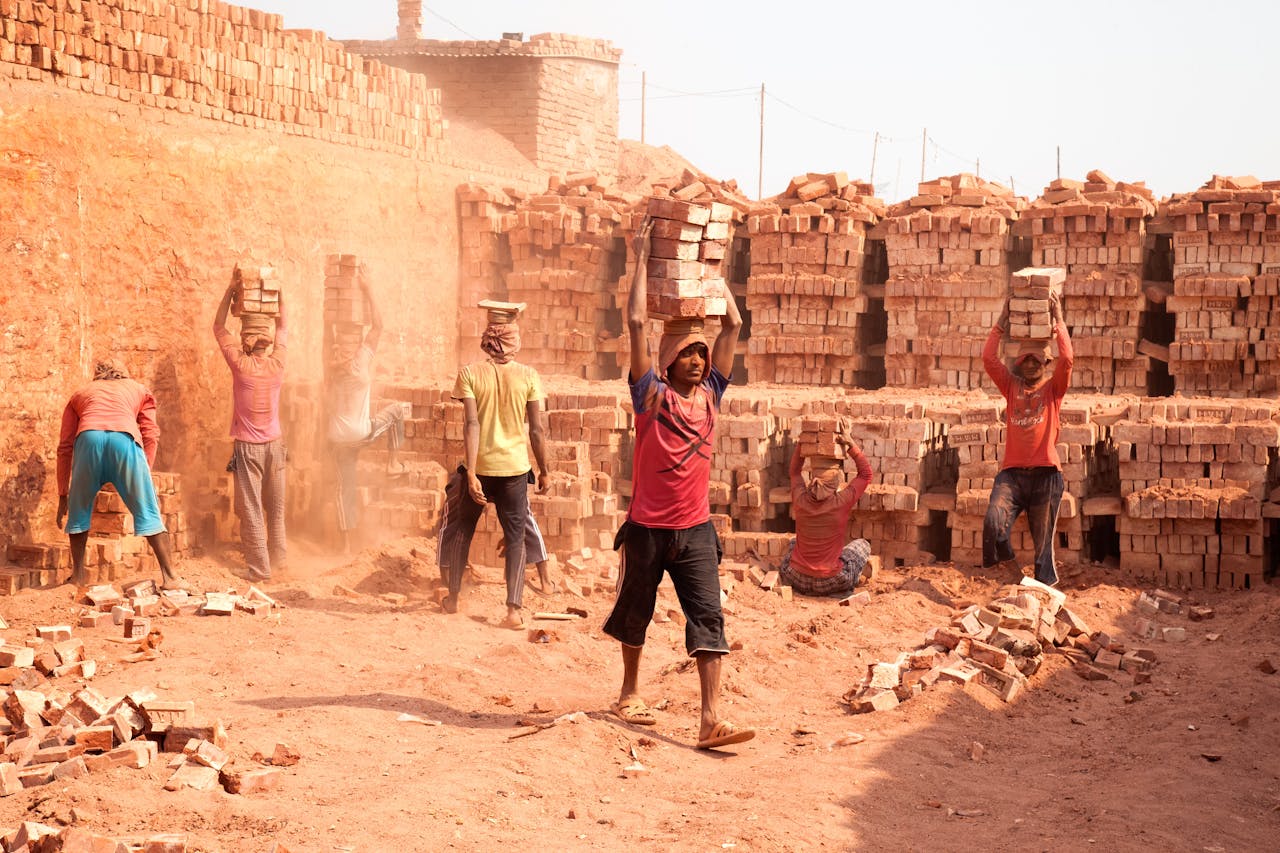
Somewhere in Punjab, right now, a child who should be in school is hauling mud under a blazing sun. A mother who dreamed of a better life for her children is instead shaping thousands of bricks a day, her hands cracked, her lungs filled with toxic smoke, her heart heavy with the knowledge that no matter how hard she works, the debt will never go away. A father is watching his children grow up in the same chains that bound him, chains made not of iron, but of a loan that was never meant to be repaid.
This is the reality of Punjab’s brick kilns. And it is a reality that Cornerstone Pakistan refuses to look away from.
A Crisis Hidden in Plain Sight
Pakistan is the third-largest brick producer in South Asia. More than 1 million men, women, and children work in approximately 10,000 brick kilns in the Punjab region alone. Yet the suffering that takes place within those kilns, behind walls of dust and smoke, in remote areas far from public view, remains one of the most under-reported humanitarian crises in the country. UK Parliament
Across Pakistan, particularly in Punjab and Sindh, more than 4 million people, many of them from religious minority backgrounds, are trapped in bonded labour in the brick kiln industry. Entire families, including mothers, fathers, and children as young as five, work long hours under scorching heat, breathing in toxic fumes, and still cannot repay debts that often began with a small loan taken out of desperation. UK Parliament
This is not poverty in the abstract. This is modern-day slavery. And it is happening today, in our province, on our watch.
How the Trap Is Set: The Peshgi System
Understanding how families end up in brick kilns, and why they cannot leave, requires understanding a system designed to ensure they never can.
The system works as follows: labourers borrow money from their employers before or after starting work at a brick kiln, for essential needs or emergencies. These borrowings are called “peshgi” or advance payment. This debt keeps each family bonded to their brick kiln, with money deducted from their wages to repay not just the loan, but also the interest on the loan. David Alton
As most workers in brick kilns are illiterate, they do not know or understand the rates being charged each month. Documentation of loans and repayments is not properly or transparently maintained at the majority of kilns, meaning workers are kept entirely in the dark about the numbers being entered into the books. David Alton
The result is a debt that grows faster than it can ever be repaid. A family takes a small loan for a medical emergency, a wedding, or simply to eat. They begin working to pay it off. But wages are so low, a family making 1,000 bricks may be paid as little as PKR 500 for their work, that repayment is mathematically impossible. The kiln owner, meanwhile, continues to add charges, interest, and fees. The debt doubles. Then triples. Then passes to the children. David Alton
As debts are manipulated upwards year after year, an overall sense of helplessness overcomes most labourers. Some families have members forcibly sold to repay debts. Others give up entirely. There have been alarming cases of workers selling kidneys to repay part or all of their debt. Al Jazeera
The Human Faces Behind the Bricks
Every brick that builds a wall in Pakistan has a human story behind it. Too often, that story is one of suffering.
Raheel and Ruth, along with their four children, spent 25 years trapped in the kilns. A loan of just $875, taken for Raheel’s mother’s leg treatment, led to years of waking at 1 a.m. to mold and haul thousands of bricks until nightfall. After their debt was finally paid off by an aid organization, Raheel and Ruth started a vegetable business and moved into a new home. Christian Post
Khalid and Shabana took a loan of $213 for their sisters’ weddings. Fifteen years later, Khalid and his young sons remained trapped, their debt having grown to $875. Similarly, Asid and Rabia took a loan for an emergency caesarean section and were held in bondage for eight years to repay $984. Christian Post
The Masih family, Arshad and Shabana, and their five children toiled in a brickyard in Punjab province for 18 years. Their elder children frequently missed school because they had to help their parents fill their brick quota. Their problems were compounded by serious health issues. Arshad had to take out a loan from the factory owner to pay for his wife and daughters’ medical treatment. Their eldest daughter, Tania, just 12 years old, suffered from a rapidly progressing muscle disease until she could no longer walk. Despite working as hard as they could, the family had no chance of ever repaying their debt. Csi-int
These are not isolated cases. They are the everyday reality for hundreds of thousands of families across Punjab, families who work harder than most of us can imagine, and receive almost nothing in return.
Children: The Invisible Victims
Of all the injustices of the brick kiln system, what happens to children is the most devastating and the most urgent.
Eleven-year-old Qaiser Dad had to give up school and work on the kiln after his father fell ill. He starts work at sunrise and does not stop until 8 pm. “I liked waking up early for school but not for this,” he said. “I don’t like what I have left behind. I wanted to become a doctor. Now I just go home and sleep. I’m so tired I don’t even get time to play with my friends anymore.” Al Jazeera
It is estimated that one in three brick kiln workers is underage, and in some brick factories, more than half are under the age of ten. As child labourers, these minors are often unable to attend school. Csi-int
Children who are forced to work under bonded labour are deprived of education, which limits their future opportunities and perpetuates the cycle of poverty within the family across generations. The child who cannot go to school today becomes the bonded adult of tomorrow. The debt that was not their fault becomes the chain they cannot break. And so the cycle continues, generation after generation, unless someone intervenes. Sparcpk
Religious Minorities: Doubly Vulnerable
The brick kiln crisis in Punjab carries a deeply troubling dimension of religious discrimination. Religious minorities constitute just 5% of Pakistan’s population, yet the percentage of religious minorities in brick kilns is often as high as 50%, especially in Punjab and Sindh. David Alton
Christian families, scheduled caste Hindus, and other minority communities are disproportionately represented in the kilns, not by choice, but because they are the most economically vulnerable, the least protected by social structures, and the most easily exploited. Weak enforcement, a lack of worker registration, and the economic leverage of kiln owners have allowed bonded labour to continue unchecked, particularly in Punjab. UK Parliament
Some kiln owners have even offered to cancel workers’ debts if they convert to Islam, placing families in the unbearable position of choosing between their faith and their freedom. This is not just labour exploitation. It is an assault on human dignity, religious freedom, and the most basic rights of Pakistan’s most marginalized citizens. Csi-int
A Law That Exists, But Is Not Enforced
Pakistan is not without laws. The Bonded Labour System (Abolition) Act was passed in 1992. Provincial legislation followed. On paper, bonded labour is illegal. But on the ground, the reality is starkly different.
Pakistan’s National Commission for Human Rights has released a study exposing systemic exploitation of brick kiln workers in Punjab, documenting bonded labour, gender-based violence, unsafe conditions, and the denial of basic labour rights. Experts described bonded labour as “an unfinished horror” and acknowledged that although laws exist, enforcement remains weak. Human Rights Research
The brick kilns are often in remote or suburban areas, so communities working at the sites frequently face major issues in accessing quality healthcare, water, sanitation, and education. They are physically isolated, legally unprotected, and socially invisible. The system continues not because no one knows, but because too few act. UK Parliament
There Is Hope – When Someone Shows Up
The darkness of the brick kiln crisis does not have to be permanent. Rescue is possible. Liberation is real. And its impact is transformational.
When Arham, a bonded believer whose family had been trapped in a kiln, was told his debts were to be settled, he said: “Words failed us. We’d never imagined escaping this vicious cycle. My children would have inherited this burden. Your prayers and support have been our lifeline. By standing with us, you’re not just offering financial relief, you’re restoring faith, hope, and dignity.” Global Christian Relief
One activist working on the front lines of this issue said, “Right now, people cannot scream here for the pain they go through daily. I want to build a proper rescue home and rescue these priceless lives.” Human Trafficking Search
These words capture exactly why Cornerstone Pakistan exists, and exactly what our Brick Kiln Rescue program is committed to doing.
What Rescue Looks Like
Rescuing a family from a brick kiln is not just about paying off a debt. It is a comprehensive journey of restoration, one that touches every dimension of a family’s life. At Cornerstone Pakistan, our approach encompasses debt liberation to break the immediate chain of bondage, legal support to ensure families have official identity documents and access to justice, safe housing and food assistance in the critical transition period, children’s education enrollment to break the cycle from the ground up, livelihood training so families can build sustainable, independent futures, and psychosocial care to help survivors heal from years of trauma, abuse, and exploitation.
Every family we reach is one family that will not pass their debt to their children. Every child we enroll in school is one child who will grow up to be free.
The Bricks That Build Our Homes
As one advocate put it: “The bricks that these workers make are used to build our houses, hospitals, schools, universities, and the parliament. But they never get to benefit from what they are making. These people are shelterless and deprived of every facility that those institutes offer. They get no education, no health facilities. The laws and judiciary systems are failing them.” Al Jazeera
The buildings of Punjab stand on the labour of people who have never known what it means to live in dignity. The least we can do, the very least, is fight for their freedom.
Stand With Us. Stand With Them.
The families trapped in Punjab’s brick kilns are not statistics. They are fathers who dreamed of better lives. Mothers who fight every day for their children. Children who still dare to dream, even when the world has given them every reason not to.
Cornerstone Pakistan is on the ground, working to reach these families, rescue them from bondage, and walk with them toward lives of freedom and dignity. But we cannot do it without you.
Your support today could free a child from a life of debt. It could send a girl to school for the first time. It could give a mother her voice and her future back.
Because every family deserves to be rescued. Not someday. Now.
To support Cornerstone Pakistan’s Brick Kiln Rescue Program or to learn more about our work in Punjab:
📧 info@cornerstonepk.org 📞 +92 346 2344829 | +92 344 2775492 📍 House No. 108, Street No. 08, Sector F/48, Francis Town, Korangi 2½, Karachi
Cornerstone Pakistan – Rescuing lives. Restoring dignity. Rebuilding futures.